Cargando...
5.9·1950·91 min·English·Dirigida por Irving Pichel
Ciencia ficciónAventuraDrama
Sinopsis
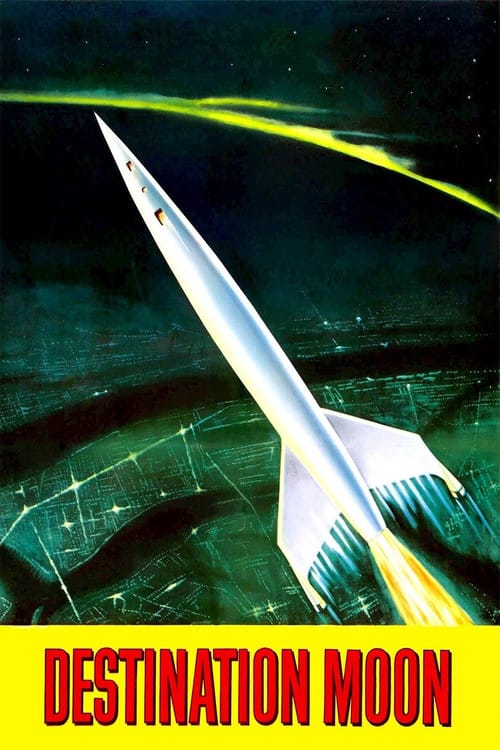
El empresario Archer, el general retirado Powers y el investigador aeroespacial Anderson colaboran en la puesta en órbita de un cohete propulsado con energía atómica. Construyen la nave espacial "Luna" en una base secreta del desierto de Mojave, pero agentes de una potencia extranjera intentan sabotearles. Cuando ven peligrar la misión, deciden adelantarse a sus enemigos y despegar con destino a la Luna...
Reparto principal

John Archer
Jim Barnes

Warner Anderson
Dr. Charles Cargraves

Tom Powers
General Thayer

Dick Wesson
Joe Sweeney

Erin O'Brien-Moore
Emily Cargraves

Steve Carruthers
Businessman at Meeting (uncredited)

Franklyn Farnum
Factory Worker (uncredited)

Jack Gargan
Businessman at Meeting (uncredited)

Everett Glass
Mr. La Porte (uncredited)

Kenner G. Kemp
Businessman at Meeting (uncredited)
Más como esto
Moon
2009·7.6
2001: Una odisea del espacio
1968·8.0
Polizón
2021·6.0
La gran sorpresa
1964·6.3
Marte (The Martian)
2015·7.7
Oblivion
2013·6.7
Cráter: Un viaje inolvidable
2023·6.6
Titán A.E.
2000·6.6

El planeta de los simios
1968·7.7
Valerian y la ciudad de los mil planetas
2017·6.7
John Carter
2012·6.4
El planeta del tesoro
2002·7.6
Communauté
6.4
Note Trakt
140 votes
10
15
9
2
8
7
7
31
6
55
5
20
4
5
3
1
2
1
1
2
455Spectateurs
14.5KCollectés
617Listes
Avis de la communauté (2)
R
robinm0★6/10Dec 12, 2025
The screenplay for this piece of 1950's classic sci-fi was partly written by and based on the works of Robert A. Heinlein. I read a large part of his canon as a teenager. His stories are noteworthy for their attention to detail, scientific accuracy & social commentary. I strongly recommend that, if you haven't read any, then you should. So, his contribution to this film is clearly visible. However, and admittedly some 75 years after it was produced, it seems more than a tiny bit flat. The characters are just too one-dimensional to convincingly carry off what is actually not a very engaging piece in the first place. It must be said that the effects are very good; state-of-the-art for the time, which is just as well. The comic character, as often happens, adds very little. Its influence can be clearly seen in many of the other sci-fi films from the era.
J
jarvis-8710259VIPCritique★7/10Sep 14, 2024
Seven years before the first man-made satellite, eleven years before the first manned space flight, and nineteen years before the actual moon landing, _Destination Moon_ distanced itself from the campy, comic space adventures of Buck Rogers and his likes, and tried to show a more realistic version of space travel on screen. Consulting with actual scientists and rocket engineers paid off. Watching this more than seventy years later, long after humanity's reason for not travelling space have changed from the pre-space-craze problems of "how" to the post-space-age question of "why", it still feels surprisingly believable, even though, as a non-expert, I can't judge much of its accuracy. I'm sure a lot of what's in this film has been refuted, especially in terms of the surface of the moon, seeing as we've actually been there now. But I like the film's attention to detail and its desire to get things right, even if it meant that audiences would have to do without fiery and thunderous explosions in space's vacuum, hostile alien races which turn out to look surprisingly like humans with some colour painted on, and a sexist love story among astronauts (or, better yet, a lone human astronaut teaching alien females about the secrets of love). This is really why _Destination Moon_ is still nice to watch today, while pretty much all science-fiction pre-Star-Trek is borderline unwatchable. Its focus on science and realism is, however, also the cause of what I felt was the biggest problem with the picture: it's a bit too on the nose, too willing to break the fourth wall to educate the cinema audience while pretending that it's actually educating clueless industrialists (although the integrated Woody Woodpecker cartoon was awesome; I even read that NASA ended up using an edited version of it), or Dick Wesson's comic relief character, who is a bit too obviously and condescendingly standing in for Everyday Joe cinemagoer. Most of the attempts at humour could also have been done away with, since it largely relies on that same unfunny character. He only has a few likeable moments, such as when he offers to [spoiler]twiddle the knobs for fun, still sure the rocket won't work; or when, in his self-sacrificing moment, he asks the others to "cut it out, take off, I wanna see it!"[/spoiler] Not a lot happens in the story, either, but that turns out not to be a problem. _Destination Moon_ didn't want to show the "most thrilling encounters in outer space" or the "most terrifying threats of tomorrow" or whichever other nonsense the trailers of space flicks spouted in the day. It wanted to tell people that travelling to the moon was a real possibility, how it could be done, and how it might look, sound, and feel. The astronauts reacting to the g forces, or their space walks, are still cool and exciting to watch even nowadays, when knowledge about the physics of rockets and outer space are more well-known. In my personal opinion, most science-fiction and space movies of the pre-70s aren't worth watching anymore today. _Destination Moon_ is an exception, even if it has its fair amount of camp and cheese.
Reseñas