Cargando...

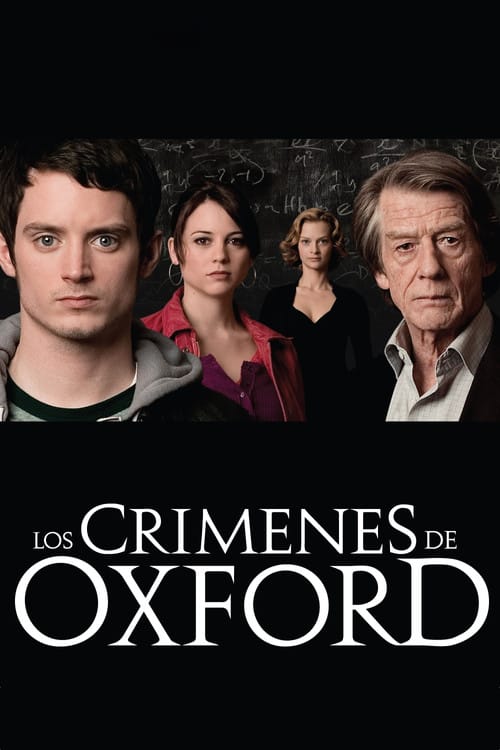
6.0·2008·110 min·English·Dirigida por Álex de la Iglesia
Lógica² + (Misterio) % Amor = Asesino
CrimenMisterioSuspense
Sinopsis
Un joven americano que estudia en Oxford descubre el cuerpo sin vida de su casera, una mujer que en su juventud había formado parte del equipo que descifró el Código Enigma de la Segunda Guerra Mundial (1939-1945). Poco después, un profesor de lógica de la universidad recibe una nota en la que se advierte que ése es el primero de una serie de asesinatos. El estudiante y el profesor deciden investigar el caso, utilizando códigos matemáticos, para encontrar el patrón que sigue este asesino en serie. Basada en el libro "Oxford Murders" (Crímenes Imperceptibles), de Guillermo Martínez.
Reparto principal










Más como esto










Communauté
6.2
Note Trakt
1.0K votes
10
50
9
24
8
144
7
213
6
324
5
106
4
82
3
21
2
27
1
28
3.1KSpectateurs
26.1KCollectés
1.3KListes
Avis de la communauté (3)
S
senbaldorVIPCritique★6/10Jun 7, 2026
# Context & Reception - Cultural Impact - Adaptation of Guillermo Martínez's novel - Exploration of the 'Academia Thriller' genre sub-set - Critical divide between plot logic and philosophical depth # Themes and Philosophy - The Illusion of Order - The absurdity of seeking patterns in a chaotic universe - The fragility of truth in the face of 'the perfect crime' - Wittgensteinian influence: Language and logic as boundaries of reality # Cinematography & Aesthetics - Visual Language - Oxford campus architecture as a labyrinthine, sterile environment - Cold color palette emphasizing intellectual distance - Geometric framing reflecting the obsession with mathematical series # Narrative Structure - Plot Mechanics - Classic whodunit structure fused with philosophical inquiry - Recursive narrative arc: The solution to the case relies on the student's own intellectual arrogance - Non-linear revelation of motive vs. action # Character Analysis - Martin (The Student) - Motivated by a desire to impress his idol - Transformation from observer to active participant - The embodiment of modern hubris - Arthur Seldom (The Professor) - Mentor figure with a cynical worldview - Represents the intersection of academia and mortality - Calculated manipulation of the narrative # Summary Insights - The film serves as a critique of the 'intellectual ego,' suggesting that logic is often used to justify irrational human desires. - The 'sequence' of murders is revealed to be a Red Herring, highlighting that the human tendency to find patterns can blind us to the randomness of evil. - There is a meta-thematic connection between the audience's desire for a logical ending and the characters' desire for a logical culprit; both are eventually denied satisfaction. - The film employs mathematical theories (Pythagoras, Gödel's Incompleteness) not just as props, but as structural metaphors for the limitations of human knowledge.
S
Spiritualized Kaos★8/10Nov 16, 2025
J
jekyl6669★6/10May 25, 2025
Although it's pretty tame by Arturo Pérez-Reverte and his frequent collaborator Agustín Díaz Yanes' usual standards, The Oxford Murders (based on the novel by Guillermo Martínez) still manages to be a decent little thriller. The film, which follows a mathematics student and a philosophy professor as they investigate a series of murders in Oxford, offers a compelling mystery with a strong intellectual bent. While fans of Iglesias's more intense works might find it a bit subdued, its clever plot and engaging characters make for an enjoyable, albeit less visceral, experience.
Reseñas