Laden...
6.3·2025·103 min·English·Regie David F. Sandberg
Jede Nacht ein neuer Albtraum.
HorrorMystery
Handlung
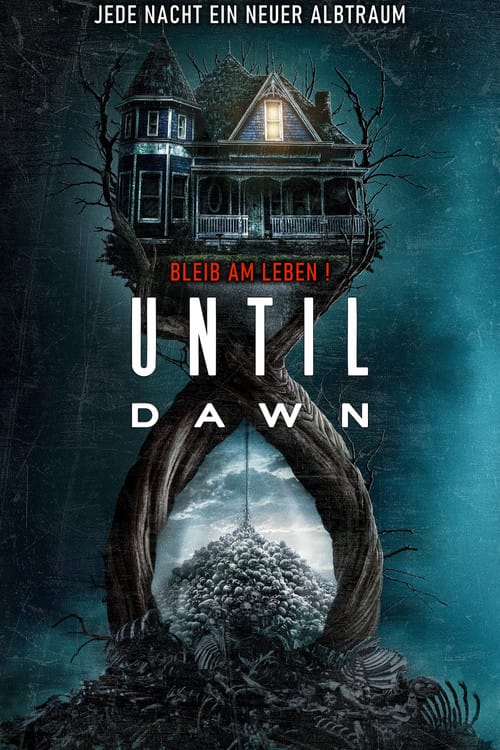
Ein Jahr nach dem mysteriösen Verschwinden ihrer Schwester Melanie begeben sich Clover und ihre Freunde auf der Suche nach Antworten in das abgelegene Tal, in dem sie verschwunden ist. Bei der Erkundung eines verlassenen Besucherzentrums werden sie von einem maskierten Killer verfolgt und einer nach dem anderen auf grausame Weise ermordet… Bis sie aufwachen und sich wieder am Anfang desselben Abends wiederfinden. Gefangen im Tal sind sie gezwungen, die gleiche Nacht immer wieder zu durchleben – nur ist die Bedrohung durch den Killer jedes Mal anders und noch schrecklicher als beim letzten Mal. Mit schwindender Hoffnung muss die Gruppe bald feststellen, dass sie nur noch eine begrenzte Anzahl von Toden verkraften kann und ihr einziger Ausweg darin besteht, bis zum Morgengrauen zu überleben.
Hauptdarsteller





Mehr wie das
Communauté
6.3
Note Trakt
9.5K votes
10
738
9
182
8
1.5K
7
1.5K
6
2.8K
5
1.2K
4
857
3
244
2
292
1
118
44.2KSpectateurs
27.9KCollectés
9.2KListes
Avis de la communauté (12)
J
JimDarko★8/10Apr 25, 2025
Really well executed. There is a lot to set up here and it is sort of rushed and kind of sloppy, but I respect the runtime because too many movies abuse that these days. The horror is well done as expected with Sandberg and there are some wonderful kills and gore. I think game people will be surprised after bitching about the adaptation based on the trailers. Let Sandberg do whatever he wants!
♥12
H
henrey713★4/10Apr 30, 2025
♥8
H
heyflpCritique★4/10Jul 29, 2025
The premise of “Until Dawn” seems like it had all the right pieces on the table: a source material full of potential, a young cast with promise, and a stylistic approach that flirts with reinventing the genre, but by the time it’s over, what’s left is just a bitter aftertaste of wasted opportunity. Based on the 2015 Sony video game of the same name, the movie kicks off with a concept that mixes slasher, time loop, and supernatural horror, like if “Halloween,” “Happy Death Day,” and “Midsommar” had a baby. But what could’ve been a creative love letter to horror subgenres ends up slipping into lukewarm execution, a lack of visual boldness, and a repetitive narrative that wears down any emotional or visual impact way before the third act. Right from the start, the film lays out its premise: five friends head out to a remote valley to investigate the mysterious disappearance of one of the girl’s sisters. Not long after, they find themselves stuck in a cycle of deaths and resurrections, hunted by a deformed clown and other monstrous entities that crawl up from the earth. With each new death, a giant hourglass on the wall flips, resetting the same night, but with tiny variations that should inject new suspense and a sense of urgency. The problem is, those variations are minimal, and the movie, which promised to play with tone and form in every “loop,” ends up stuck in the same generic and predictable kind of horror, dropping the ball on becoming a reinvented experience each time the night restarts. What begins as a mystery with tons of potential turns into a messy patchwork of cheap jump scares, noisy CGI creatures, and loud bangs pretending to be real tension. One of “Until Dawn’s” biggest sins is its failure to visually translate the richness of its concept. Maxime Alexandre’s cinematography is lazily dark, without the contrast needed to build mood, and David F. Sandberg’s direction is robotic, recycling formulas instead of exploring all the cool stuff a time loop could offer. There’s no style, no visual identity, no sense of surprise. Even the gore, which in other slashers makes up for lack of depth with creative nastiness, is handled here in the most boring, by-the-numbers way. The sequence where water causes the characters to literally explode is one rare burst of creativity, but it gets quickly buried under yet another round of generic deaths and pointless running. And when it comes to characters, the script also drops the ball. The dynamics between the five teens are shallow, the dialogue constantly circles the same tired conflicts, and the traumas that could’ve added emotional depth are barely scratched. Even with promising names like Ella Rubin, Odessa A’zion, and Ji-young Yoo, there’s just not enough material for them to build anything more than your typical “final girl” or reckless boyfriend archetype. Ji-young Yoo, in particular, who’s been showing up in more complex roles recently, is totally wasted in a character that hints at psychic powers but ends up just spewing exposition. In the end, “Until Dawn” is frustrating because you can see glimpses of what it could have been. Peter Stormare’s presence as a character that directly nods to the game is great fan service, and there are a few isolated moments of tension – the repeating names in the guestbook, the hourglass, the frozen-in-time house – that show there was a strong idea at the heart of this project. But with each reset of the night, the film loses itself a little more, reusing the same formula without growing the story or the visuals, like it’s trapped in a creative loop it can’t escape from. In the end, “Until Dawn” is an adaptation that forgot the soul of its original material: the sense of control, the weight of your choices, the unpredictability of each decision. By going down a safe and unimaginative path, the film becomes the exact opposite of what the game stood for. All it really does is make you want to pick up a controller and live this story the right way: making your own choices and hoping this time, everyone makes it out alive.
♥4
J
jrh-115VIP★7/10Apr 30, 2025
♥4
M
musa_ftw★7/10Apr 30, 2025
♥4
Kritiken