Cargando...
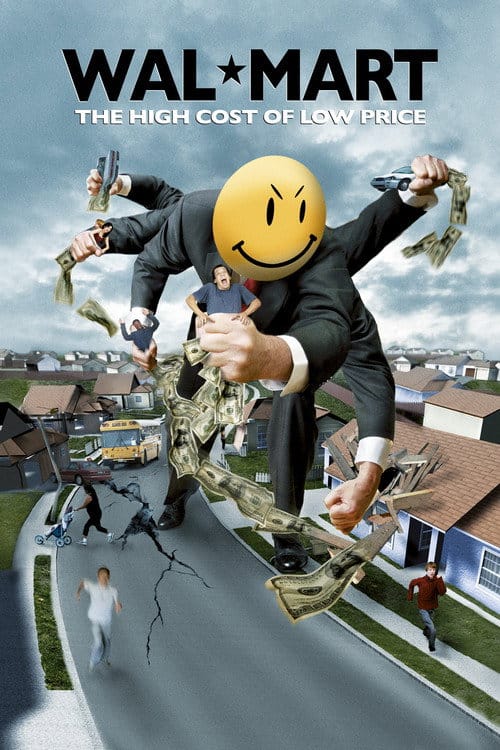
6.3·2005·98 min·English·Dirigida por Robert Greenwald
Documental
Reparto principal

Lee Scott
Himself - President & CEO of Wal-Mart (archive footage)
Don Hunter
Himself - H&H Hardware Owner
Jon Hunter
Himself - Son of Don Hunter
Jeremy Hunter
Himself - Son of Jon Hunter
Matt Hunter
Himself - Son of Jon Hunter
Johnny Faenza
Himself - H&H Hardware Employee
Frank Mormino
Himself - Owner of Middlefield Tire
John Bruening
Himself - Owner of Geauga Vision (as Dr. John Bruening)
Tom Glassburner
Himself - H&H Hardware Employee
Weldon Nicholson
Himself - Wal-Mart Store Manager Trainer
Más como esto
Inequality for All
2013·7.5
The Class of ‘92
2013·7.1
180° South
2010·7.2
John Candy: Yo me gusto
2025·7.9
Matrix: Descubre lo increíble
2001·6.9
Mi mama Jayne: una película de Mariska Hargitay
2025·8.0

Todas las habitaciones vacías
2025·7.3

Corazon de Perro
2015·6.5

Jesus Camp
2006·7.0

Despertando a la Bella Durmiente
2009·7.2
La reina de Versalles
2012·6.9
Inside Job
2010·7.7
Communauté
6.7
Note Trakt
290 votes
10
37
9
4
8
74
7
40
6
79
5
11
4
16
3
8
2
19
1
2
474Spectateurs
55.7KCollectés
467Listes
Avis de la communauté (4)
V
VWFringe★10/10Dec 15, 2020
This is an important film to watch. It is our civic duty to understand points of view other than the monied ones. Call me crazy, and I have been looked at as if I am when I do it, but I've often apologized to cashiers at Walmart by saying, "I'm sorry they took my discount out of your paycheck." After watching this I was actually clean and sober of shopping at Walmart for several years, but after being unemployed for all of those years I started shopping there again once a month to stretch my EBT benefits. I am not proud. I still believe that the only way to kill a bad corporation is to stop feeding it.
♥1
D
dgwCritique★6/10Feb 22, 2018
Before I get into any critiques (given below in the same order I thought of them), I just want to disclaim that my rating has nothing to do with the factual content of this film. When rating documentaries, I look at production quality and creative decisions made—how the information is presented, rather than the information itself. It wouldn't be fair to rate an awful documentary 10/10 because I agree with it, nor would it be fair to rate an impeccably produced documentary 1/10 because I disagree with the viewpoints presented. That said, this documentary is very clearly against Wal-Mart. It's clear from the title alone. I don't agree that all of the misdeeds presented herein are actually Wal-Mart's responsibility, but I do agree with many of them. However, the only pro–Wal-Mart viewpoints shown were in footage of the CEO speaking at an annual meeting, and I would argue that Robert Greenwald could have balanced the opinions presented a bit (a lot) better. ---- There's a whole section in this documentary on Wal-Mart's health insurance. The Affordable Care Act was signed into law four and a half years after this documentary came out, and that accelerated the upward spiral of health insurance costs. At first, when they started talking about healthcare, my first thought was, "Is this still accurate?" But if anything, the likelihood of Wal-Mart changing its approach to providing its workers with healthcare is unlikely to have changed. Meanwhile, health insurance costs have done nothing but rise since this documentary came out. I doubt Wal-Mart's company policies have gotten any cheaper (or even stayed the same price) amidst the rising tide of market rates. One technical/creative decision that bothered me over the course of the film was the choice to "add variety" to the shots by using mirrored footage of interviewees. When some of the people talked for "too long" and there was no relevant footage to cut away to, the interviewee's image would be quite literally mirrored on the horizontal axis. That meant the background flipped, and any jewelry or accessories the person might be wearing would be suddenly on the other side of their face. It was honestly quite distracting. The other recurring creative choice that got on my nerves was the "freeze frame and fade to black and white for text" effect used in nearly every segment. It really disrupted the flow, I thought, and the same facts and figures could have been presented over other shots. Freezing the video and forcing the viewer to focus _only_ on the text itself feels a little insulting, like the director doesn't think the viewer can pay attention to the text if _anything_ else is happening on screen or in the audio track. The one where the text was placed in a cardboard compactor with motion tracking and masking to follow the video (which didn't freeze-frame that time) was marginally better. That said, the facts presented in context, during the "Actual Wal-Mart Commercial" bits, were the exception to this complaint. Those worked extremely well (and realistically could not have been presented another way). Honorable mention goes to the relatively short, but repeated, instances of obvious audio desync during certain interview segments. It doesn't happen most of the time, but during the interviews when it does it should have been easy to fix during editing. In the segment on China, it really bugs me that the subjects' names are translated into English nicknames of sorts in the lower third. Their names should be transliterated, but not translated; the translations aren't really relevant. A name is a name, not a word, and shouldn't be treated as a word. The original Chinese audio is also much too quiet compared to the translator's voice, in my opinion. ---- It has nothing to do with the film itself (and thus, no impact on my rating & review), but I question the decision to release this documentary in HD on Amazon Instant Video. It clearly wasn't filmed at particularly high quality, and the image quality is downright awful for most of it. The extra pixels do nothing for the film—and screenshots I've seen of the original DVD release actually look better.
♥1
T
TKPNPodcast★3/10Jul 20, 2025
A simple hit piece. Not really attempting to tell a story beyond the preconceived story. I will give them that at the time Amazon was not there so it didn't have that perspective, but it had no intention of being balanced anyway. The truth is, no matter how big and bad you are, something always comes along that's bigger and badder. Now, we can actually name it.
S
SpeedDemon★9/10Feb 15, 2021
This is a real eye-opener and a movie everyone should see. I won't be so dramatic as saying I'll never shop there again, but I will do everything in my power to spend my money in any store - other than Wal-Mart. I feel sorry for everyone that works there and has to endure what they go through to make a 'living' As a side point, my wife worked there for a day and a half and quit - she was told to lie to the customers and deceive them as much as possible. Not only that, but she was given a locker to store her purse that was hers exclusively, only to find out someone else was also using it.
Reseñas