Loading...

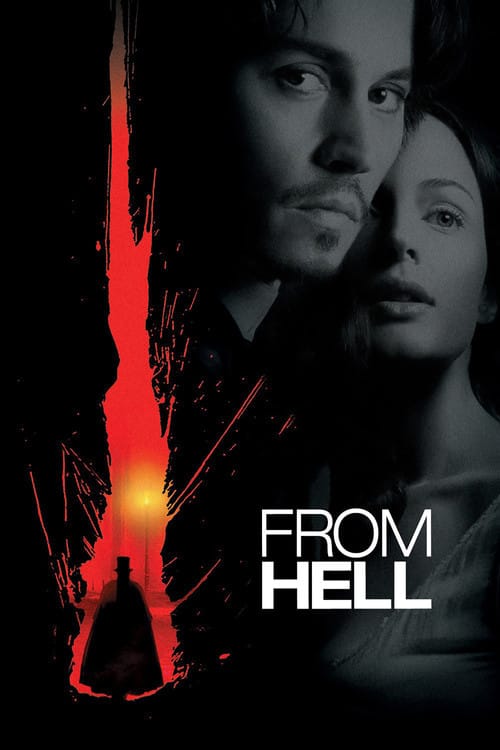
6.7·2001·122 min·English·Directed by Albert Hughes
More than the legend will survive.
HorrorMysteryThriller
Synopsis
Frederick Abberline is an opium-huffing inspector from Scotland Yard who falls for one of Jack the Ripper's prostitute targets in this Hughes brothers adaption of a graphic novel that posits the Ripper's true identity.
Main Cast









More Like This



Communauté
6.8
Note Trakt
3.6K votes
10
276
9
145
8
698
7
1.1K
6
894
5
296
4
118
3
53
2
27
1
30
13.0KSpectateurs
88.9KCollectés
7.0KListes
Avis de la communauté (11)
A
AlecTrias★8/10Mar 15, 2022
One of the few movies I have on DVD. So when I moved to a new apartment, which has often been the case, I always had no Internet at first. Consequently, I always watched the movie on the first day after my move. Quite comfortably between unassembled cabinets and boxes, I always had a comfortable home feeling. :)
♥3
J
jekyl6669★6/10Apr 2, 2017
Decent adaptation of a superior graphic novel that had a very interesting take on the case. I expected a bit more grit from the Hughs brothers, but they still delivered a pretty good movie.
♥1
T
trench★10/10Sep 20, 2013
Cool
♥1
S
senbaldorVIPCritique★7/10Jun 7, 2026
# Context & Legacy - Origins - Adaptation of Alan Moore and Eddie Campbell's graphic novel - Historical reality vs. conspiracy theory mythology - Reception - Criticism regarding departure from graphic novel grit - Praise for set design and period accuracy # Themes & Symbolism - Power & Corruption - Masonic influence as a state-sanctioned veil - Protection of the royal bloodline at the cost of human life - Visual Metaphors - The scalpel as a surgical, precision-based evil - Blood and fog representing obfuscation and the loss of life # Cinematography & Aesthetics - Visual Language - Desaturated, sepia-toned palette reflecting decay - Expressionistic lighting in alleyway scenes - The 'Ripper vision' sequence: shifting camera focus and frantic editing # Narrative & Structure - Plot Progression - Procedural investigation of Jack the Ripper - Supernatural clairvoyance as a tool for detection - Shift from police thriller to institutional conspiracy - Narrative Style - Non-linear visionary sequences - Gothic noir atmosphere - Duality of Victorian prosperity vs. East End decay # Character Dynamics - Frederick Abberline - Tragic hero archetype - Dependency on laudanum as an escape - Ethical conflict between duty and personal trauma - Mary Kelly - Symbol of the oppressed class - Emotional anchor for Abberline - Final survivor of the Ripper's purge # Summary Insights - The film transforms a criminal investigation into a critique of class stratification, where the state 'sanitizes' problems by silencing the marginalized. - Abberline's drug-induced visions serve as a narrative bridge between rational police science and the irrational, dark reality of the Ripper's ritualistic killings. - The use of Masonic symbolism reflects the Victorian-era obsession with secret societies as symbols of hidden, unchecked power structures. - The cinematography emphasizes claustrophobia, trapping both the characters and the audience in the labyrinthine, fog-drenched streets of Whitechapel. - By focusing on 'The Five' victims, the film attempts to humanize the statistics of history, contrasting the victims' fragile humanity against the cold, clinical precision of the perpetrator.
T
TheLazyReviewer★7/10Apr 8, 2024
Film 157 (Goal: 300) of 2024: Having never read the graphic novel by Alan Moore, being interested and not well versed on the subject matter of Jack the Ripper, and being a Johnny Depp fan, I was eager to watch From Hell. A police drama, psychological horror that focuses on Jack the Ripper, his murder of a bunch of prostitutes, and the cop (Depp) that tries to catch him. I really enjoyed From Hell, especially the first two acts. The last 25 minutes drop the ball slightly as the film delves into almost supernatural territory. The reveal also wasn't what I hoped for. Otherwise the complete package outweighs the sum, and my own personal storytelling desires.
Reviews