Laden...

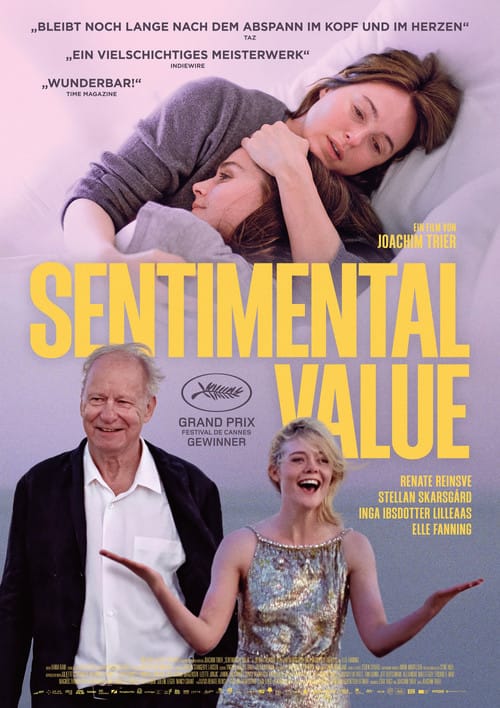
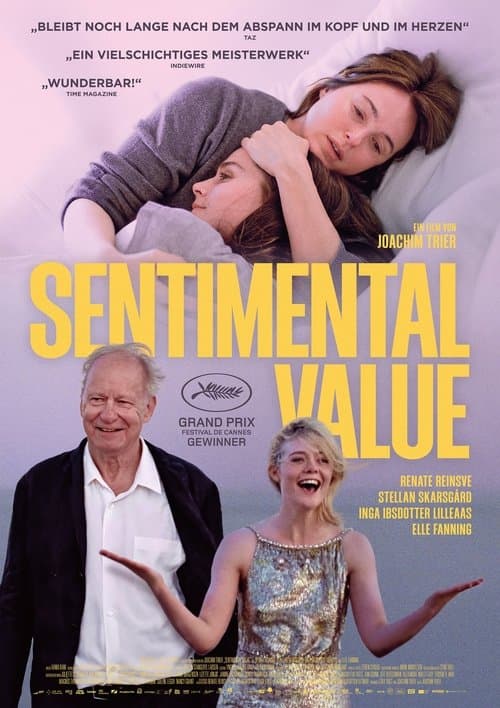
7.4·2025·133 min·no·Regie Joachim Trier
Drama
Handlung
Nora und Agnes verbindet eine komplexe Beziehung zu ihrem Vater, der seine Arbeit stets über die Familie stellte. Nun steht Gustav nach Jahren der Funkstille plötzlich wieder vor der Tür – mit einem charmanten Grinsen und dem emotionalen Gepäck eines halben Lebens. Augenblicklich geraten alte Familiendynamiken ins Rollen. Und nach und nach wird deutlich, dass sich Vater und Töchter ähnlicher sind, als sie glaubten. Vielleicht ist es doch nicht zu spät für einen Neuanfang?
Hauptdarsteller









Mehr wie das





Communauté
7.8
Note Trakt
4.5K votes
10
842
9
565
8
1.5K
7
641
6
590
5
110
4
134
3
22
2
27
1
12
17.3KSpectateurs
13.2KCollectés
10.9KListes
Avis de la communauté (12)
S
Saint Pauly★6/10Aug 26, 2025
Like a house up for sale: solid and pristine, but full of other people's memories. It felt a bit cold and empty for me. An actress and her director father dance around their estrangement in the family home. Technically, of course, the film is extremely well-made, but the title says everything. Something that has 'sentimental value' is something that's special to a select few who have a history with the thing, but means less to those of us who are on the outside looking in.
♥10
R
RG9400VIPCritique★5/10Dec 5, 2025
Sentimental Value opens up with a cold open with a melodic soundtrack as the camera pans across a home, voiceover narration quoting an essay about the life of the family within, told from the perspective of the house itself. As it starts to talk about the fractures and shows a literal crack snaking its way from the foundation up through the walls, the title hits. I was excited, thinking I was about to watch a surefire hit. Indeed, I really liked Joachim Trier's prior movie The Worst Person in the World, and I think Renate Reinsve is incredibly talented. Unfortunately, the rest of the movie did not live up to these expectations. I found it very dry, with way too many scenes oriented around making a movie. I've found that critics tend to be a lot more generous with their reviews when a movie focuses on the act of filmmaking, and I can't help but feel that is what happened here as well. There is a level of navel-gazing here, often when focusing on Stellan Skarsgard as the patriarch of the family. I found those scenes to be boring, incredibly boring. The movie is the best when the voiceover narration is playing, and the story flashes back to older generations that lived in the home. Renate is great here as well, but I struggled to connect to her character because so much of this movie gets wrapped up in this dumb movie script. I get that it acts as an analog for the family's issues, but why bother with that facade in the first place? I would rather have the movie dive deeper into her depression and longing for a home. There is a strong scene at the ending between the two sisters, but I just wish the rest of the movie had that level of pathos. I think it should have explored those family dynamics and Nora's depression more directly. Elle Fanning is also in this movie, and she kind of does things. She's great though, so no complaints. Overall, a disappointing misfire that could have been really good had it not been wrapped up in itself to such a large degree.
♥6
C
captnigloJan 22, 2026
♥5
B
Bradym03Critique★9/10Nov 26, 2025
LIFF39 2025 #3 What we do in the past often comes back to haunt us. The hurt is still raw, and a simple ‘sorry’ may not heal all wounds, but second chances are possible. In "Sentimental Value," the story centres on confronting unresolved family tensions, giving the film its emotional depth. The film centers on sisters Nora (Renate Reinsve) and Agnes (Inga Ibsdotter Lilleaas), along with their father, Gustav (Stellan Skarsgård), a renowned arthouse director eager to revive his career and reconnect with his daughters after a long absence. He reenters their lives when he offers Nora, a stage actress, a role in his upcoming film—an autobiographical screenplay he wrote about his mother, who took her own life in their family home in Norway, and the traumatic events during World War II. But when she declines the offer, he casts American actress Rachel Kemp (Elle Fanning) instead. Among all the films I’ve seen at this year's festival, this one is definitely the best. I was utterly captivated by it. It’s an emotional journey where every character and performance feels genuine. The film demonstrates how the arts—especially acting, writing, and directing—serve as metaphors for reconnecting with loved ones and healing. The arts are often used to express what we want to say but can’t, so instead, we let the work we create speak for us. It’s powerful and deeply moving. Great performances from everyone. Stellan Skarsgård, Renate Reinsve, Inga Ibsdotter Lilleaas, and Elle Fanning were fantastic, bringing their roles to life—no wrong notes. Especially with the character of Rachel Kemp, whom I initially thought was a typical silly American, “omg let's take a selfie *peace sign*” type of person. Instead, director Joachim Trier moves away from that and presents a thoughtful, nuanced character eager to be taken seriously as an artist. In one scene during an interview, an absolute idiot of an interviewer speaks to her in a condescending tone. Everyone around her won’t give her a big break until Gustav arrives. But she’s a talented actress, with one excellent scene where she delivers an emotional monologue from the script and performs it in front of Gustav; both Kemp and Elle Fanning nail it. Although it’s an emotional and moving exploration of family issues, the film maintains a sense of hope, showing that not everything is doom and gloom, which I found refreshing and satisfying. Overall, it's a beautifully crafted film. The burning question you’re left with is: Can you ever forgive, even with a broken heart?
♥5
F
fasterfilmcritic★6/10Jan 10, 2026
I cannot criticize Sentimental Value. The film is great. I loved some of the cinematography and the acting was on point. The story just didn't grab me. Moments of it did, but as a whole, it just didn't pull me in.
♥2
Kritiken