جاري التحميل...
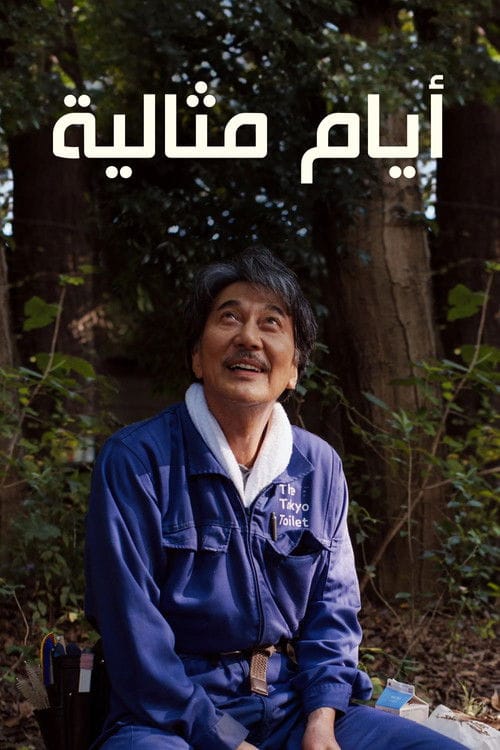
7.8·2023·64 min·日本語·إخراج فيم فيندرز
في عالم من اللحظات الزائلة، ابحث عن الجمال الخالد.
دراما
ملخص
هيراياما راضٍ بحياته كمنظف للمرحاض في طوكيو. خارج روتينه المنظم، يحب الموسيقى على أشرطة الكاسيت والكتب والتقاط صور للأشجار. من خلال لقاءات غير متوقعة، يفكر في العثور على الجمال في العالم.
الممثلون الرئيسيون







المزيد مثل هذا

طفل Kamiarizuki
2021·6.5

Little Forest: Summer/Autumn
2014·7.8

إيكيرو
1952·8.3

Call Me Chihiro
2023·7.2

Little Forest: Winter/Spring
2015·7.8
After the Storm
2016·7.2

Okko's Inn
2018·7.2
Every Day a Good Day
2018·7.2
Our Little Sister
2015·7.6
Sweet Bean
2015·7.5
Night on the Galactic Railroad
1985·7.2

الشر لا وجود له
2023·6.8
Communauté
8.1
Note Trakt
6.6K votes
10
1.7K
9
990
8
2.1K
7
883
6
553
5
136
4
117
3
19
2
55
1
28
20.3KSpectateurs
29.1KCollectés
12.7KListes
Avis de la communauté (12)
G
gak84★10/10Jan 29, 2024
Komorebi: The sun's rays filtering through the leaves, creating a pattern that is never repeated twice and therefore exists only in that moment. Like even the simple and uneventful days of our lives. Each day can never be lived the same twice so it is special and perfect because it only exists once. A beautiful movie, or poetry, to remind us to be grateful for each single day. They are all perfect.
♥42
L
lancebridgesVIP★9/10Mar 15, 2024
Next time is Next Time. Now is Now.
♥21
R
RG9400VIPCritique★5/10Jan 26, 2024
I wanted to enjoy this movie a lot more than I eventually did. It has a beautiful score and a very gentle style of filmmaking. With limited dialogue, we follow our main character across his daily routine, seeing the subtle shifts in his emotions based on limited interactions with other characters. Conceptually, it is a very subdued approach with a potential to pack an emotional punch. In execution though, I found myself getting detached from the events at numerous points. Make no mistake, there are specific scenes where I was fully engaged, especially when it felt like we were going to get more about our protagonist's history. However, Wim Wenders often pulled back before actually giving us something substantial, instead leaving a lot to the viewer's imagination. Because of it, the movie feels like it *could* be brimming with depth, but to be honest, it never really gives us evidence of that depth. The characters are kept at an arm's distance, and this prevents the type of emotional connection and resonance that I prefer with movies. It also means that the ending feels abrupt because a lot of the side characters who have come in and out of the movie never really have their arcs resolved. I was impressed with the acting though, since all the communication happens through Koji Yakusho's face due to the limited dialogue.
♥19
B
ben.tevesCritique★9/10Mar 8, 2024
I didn’t want to leave my apartment this afternoon. I had the day off, and I’d spent most of it wasting away in my bed and on my couch, reveling in the nothingness of an empty schedule. But as the clock ticked towards 3pm, my desire to see all of the Oscar-nominated films finally overpowered my lethargy. I gathered myself up, found the motivation drive to the theatre, rewarded myself with a little snack from concessions, and sat in my seat for Perfect Days just as Nicole Kidman was telling the audience that “we make movies better”. I’m so glad that I went. Hirayama (Koji Yakusho) is an aging sanitation worker in Tokyo who has every part of his day down to a science: wake up, fold the linens, brush his teeth, water the plants, grab a coffee, go to work cleaning public restrooms, come home, wash up at a bathhouse, go to dinner, go home, read, and go to sleep. Rinse and repeat, day in and day out. It’s a modest life, but it’s immensely pleasant. There really couldn’t have been a more appropriate mood for me to be in for this film. Much like me earlier in the day, Hirayama takes pleasure in the small things; listening to 80’s cassette tapes on his commute (which is, in a masterful production decision, the only music we hear in the film), tending to his plants, or taking photos of the trees during his lunch breaks near a temple. His indulgence in his commute environment is relatable to anyone who does the same; while waiting in traffic, we create a domain of our own within our vehicles that feels impenetrable by the outside world, despite the only barrier being transparent glass. We see his eyes light up when a homeless man dances alone in a park, or when a tourist is delighted by the technology behind Tokyo’s transparent restrooms. Hirayama barely speaks; he’s a man of so few words, he appears to be belligerently quiet in some situations, like when his yammering coworker goes on and on about a woman he’s hopelessly attempting to woo. Hirayama isn’t rude — he simply has nothing of substance to contribute at times, so he abstains; something that I think a great deal of people in modern society could learn from. He is, however, listening and observing at all times, waking up when most of Tokyo still sleeps, and moving through the city like a ghost. There’s a commentary on the social treatment of public servants here (which is revisited later), particularly in a poignant moment when Hirayama returns a lost boy to his mother. The mother does not acknowledge Hirayama whatsoever, but the boy turns to wave goodbye to him as they walk away. Hirayama, always enamored with simple joys, simply laughs and waves back. At roughly the one-hour mark, Hirayama’s steady rhythm of workdays is disrupted when his niece appears, having run away from home after an argument with her mother. This point flips the perspective that we’ve seen thus far, taking us out of Hirayama’s comfortable monotony and showing us how it looks to someone else who doesn’t know it to be theirs. He shares a few of his days with her, and imparts a profound piece of wisdom on her: “Next time is next time. Now is now.” When Hirayama’s estranged sister inevitably comes to collect her daughter, pulling up in a Lexus driven by her chauffeur, she asks him with thinly veiled distaste if it’s true that he’s cleaning toilets for a living. As they drive away, Hirayama is overwhelmed with a sense of shame inflicted by his sister’s question. Shortly after, Hirayama has a chance encounter with a man undergoing cancer treatment with weeks left to live. It’s a seemingly unrelated occasion, but the masterful thing about this movie is how such separate moments can affect someone’s state of mind so completely. I won’t spoil the resolution, but it involves a long take and an incredibly cathartic needle drop of Nina Simone’s “Feeling Good” that’ll hopefully have you reenacting the moment in your car. On paper, Perfect Days doesn’t sound like a particularly interesting movie. But through a touching performance by Koji Yakusho, deft editing, carefully measured reservation, and a solid selection of well-placed needle drops, the film delivers a powerfully cleansing examination of what it means to live a simple life, and to savor every small joy that it brings.
♥12
M
Maeldun★7/10May 25, 2024
It's a wonderful thing to be able to find beauty in mundane things and be entertained by everyday life.
♥11
المراجعات