Chargement...
7.3·1989·124 min·English·Réalisé par Peter Greenaway
Luxure... Meurtre... Dessert. Bon appétit !
CrimeDrame
Synopsis
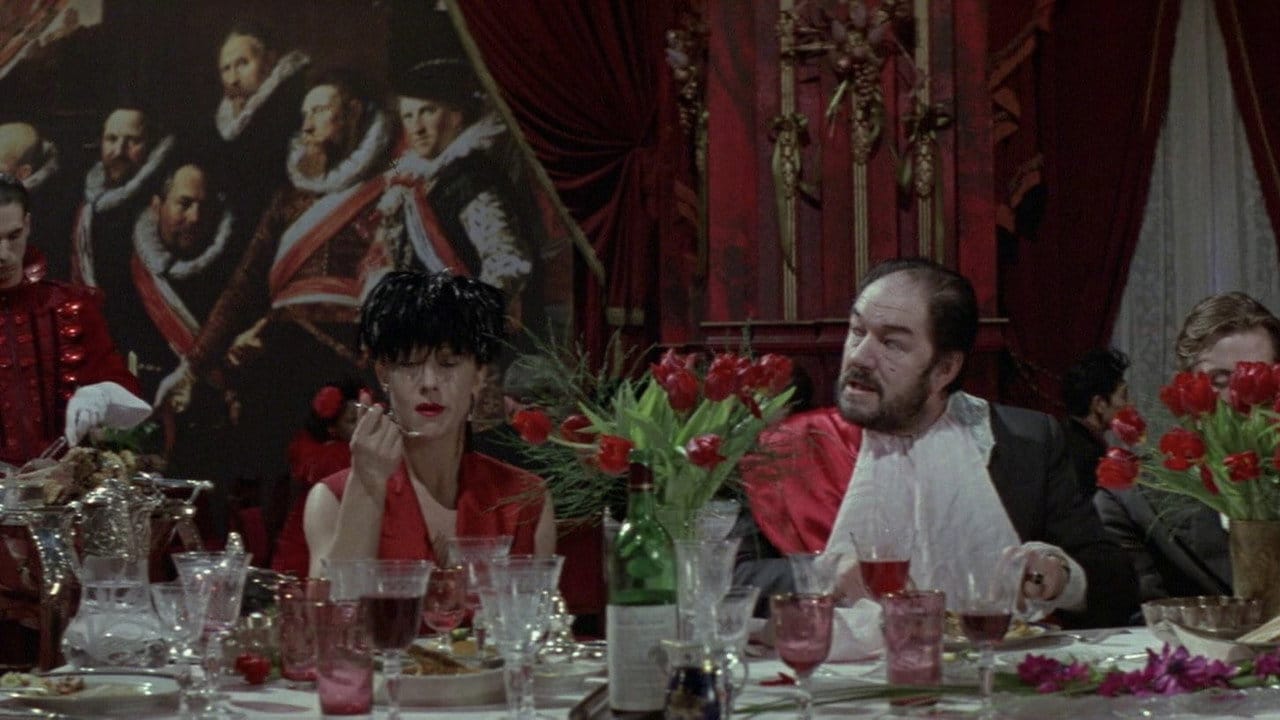
Albert et ses hommes, de sinistres malfrats, sont les habitués du « Hollandais », un restaurant huppé tenu par Richard, un cuisinier français. Un soir, Georgina, l'épouse de l'odieux gangster, remarque un client solitaire et taciturne qui mange, le nez plongé dans ses livres. Fascinée, elle ne tarde pas à se donner à lui. L'homme est en réalité un libraire. Bénéficiant de la complicité du cuisinier, les deux amants trouvent régulièrement refuge dans les toilettes, les réserves ou encore la cuisine du restaurant. Lorsqu'Albert découvre enfin l'infidélité de Georgina, il entre dans une rage folle. Sa réaction est d'une rare violence…
Acteurs principaux









Plus comme ça




Communauté
7.3
Note Trakt
1.0K votes
10
161
9
110
8
276
7
210
6
135
5
54
4
38
3
15
2
28
1
19
2.7KSpectateurs
21.4KCollectés
4.9KListes
Avis de la communauté (12)
S
smallclone★8/10Jul 24, 2018
Just WOW. You can have all the expensive digital cameras in the world, but this movie shows that lighting, set design and Direction can make a movie. It's an extraordinary film - beautiful, bizarre and barbaric. I've read previously that it has political undertones but I just let the film assault my eyes and brain for the crazy dream like experience that it is. I was mesmerized by the very first frame and didn't stop until the credits rolled. It unfolds like a play, and even the first shot resembles curtains being drawn for act 1. Food, sex and violence are constant themes as the rich gorge on ridiculous dishes and the poor work in the kitchens. It's a stunning film to watch in High Definition, and Michael Gambon is terrific as the vile villain.
♥3
H
hriday.VIP★8/10Mar 14, 2023
Watching this movie is like taking a class in filmmaking.
♥1
T
TvTrav3lerVIP★7/10Feb 22, 2020
3 Thoughts After Watching ‘The Cook, the Thief, His Wife & Her Lover’: 1. I watched this after hearing it disturbed director Ari Aster (Hereditary, Midsommar), whose films are a bit disturbed in their own right. But I didn’t find this film to be all that disturbing. 2. I never thought I’d hate hearing Dumbledore speak SO much. 3. There were some tiny details I didn’t fully understand — BUT I give the film points for originality and a super unique aesthetic. And I was never bored.
♥1
S
soonertboneVIP★9/10Mar 3, 2026
A wondrous, voracious, delicious assault on the senses both caustic and divine. Truly thrilling to watch for the first time, I was enthralled with the pounding score, the dramatic colorscapes, and the indescribable performance by Gambon. Outstanding.
N
NealZVIPCritique★8/10Apr 23, 2025
The movie begins with a grab by the throat, drawing you into a world that initially seems cruel and disturbing, but even there you can choose to see the beauty in the world. You quickly realize that the film is less about the plot than about the experience – an experience that is loud, brash, and unforgiving, like a feast for the eyes and ears. Each scene feels as if it stands on its own. Everything is staged for this one moment and fits together at the end like a puzzle piece. The main characters are all trapped in their own prisons – Albert Spica (Michael Gambon), the tyrannical and violent thief, holds court in his restaurant, a grotesque parody of power and wealth. His wife, Georgina (Helen Mirren), silently endures his cruelty; her life is a silent rebellion in every look and every action. And then there's her lover (Alan Howard), the silent, almost invisible refuge in the chaos. It's a triangle of power, lust, and revenge, played out in a world of excess. What makes the film unforgettable is its visual assault. The staging is almost unbearable — the costumes, the sets, the colors — everything is carefully crafted to create a world that is both seductive and repulsive. The violence, too, is relentless, never shying away from the ugliness of humanity. But it's not just the images; it's the way the film builds tension. Georgina's slowly growing defiance, her silent revolt against her husband's abuse, is palpable. It's a film about escape, but also about the price of that freedom. The scenes feel like paintings, inviting you to lose yourself in their stillness and composition. But that beauty competes constantly with the chaos. The overwhelming excess — in visuals, sound, and mood — makes it hard to follow the story with real passion. Many conversations aren’t meant to be understood, but to be seen. The dialogue often seems less about meaning and more about reinforcing the imagery. It’s all part of the atmosphere, but that makes it hard to stay emotionally connected. Only the music, and certain striking scenes, manage to pull you back in. The soundtrack, too, serves more than just atmosphere. It's another figure in the room that heightens the emotional tension, shifting from the loud, chaotic sounds of Spica's world to the quiet, intimate moments between Georgina and her lover. The score doesn't just support the visual impressions — it amplifies them, making every moment seem as if it's about to explode. The film takes a while to get going and for you to fully realize what's being done to you. It's both stressful and calming at the same time, and the visual differences between the individual scenes make it seem significantly larger than it is, as the locations are quite manageable. Everything builds to a thrilling and terrifying climax, where every decision feels like a step toward inevitable destruction. I never would have expected how it all plays out in the end. Such raw and honest violence, so oppressive and triumphant. In any case, a good contrast to the otherwise beautiful and tasteful rest of the film. Even though I can absolutely see how well this film is crafted — and how bold it is to even attempt something this chaotic and uncompromising — I have to admit that, personally, I wish it had taken some different turns here and there. The contrast between the things I loved and the things I found frustrating is intense, and that makes it really hard to judge. But hey, I'd rather lean positive than get stuck in complaints, so I'm rounding up. Because even when it's too much, at least it's never boring.
Avis