Loading...
7.1·2001·146 min·English·Directed by Steven Spielberg
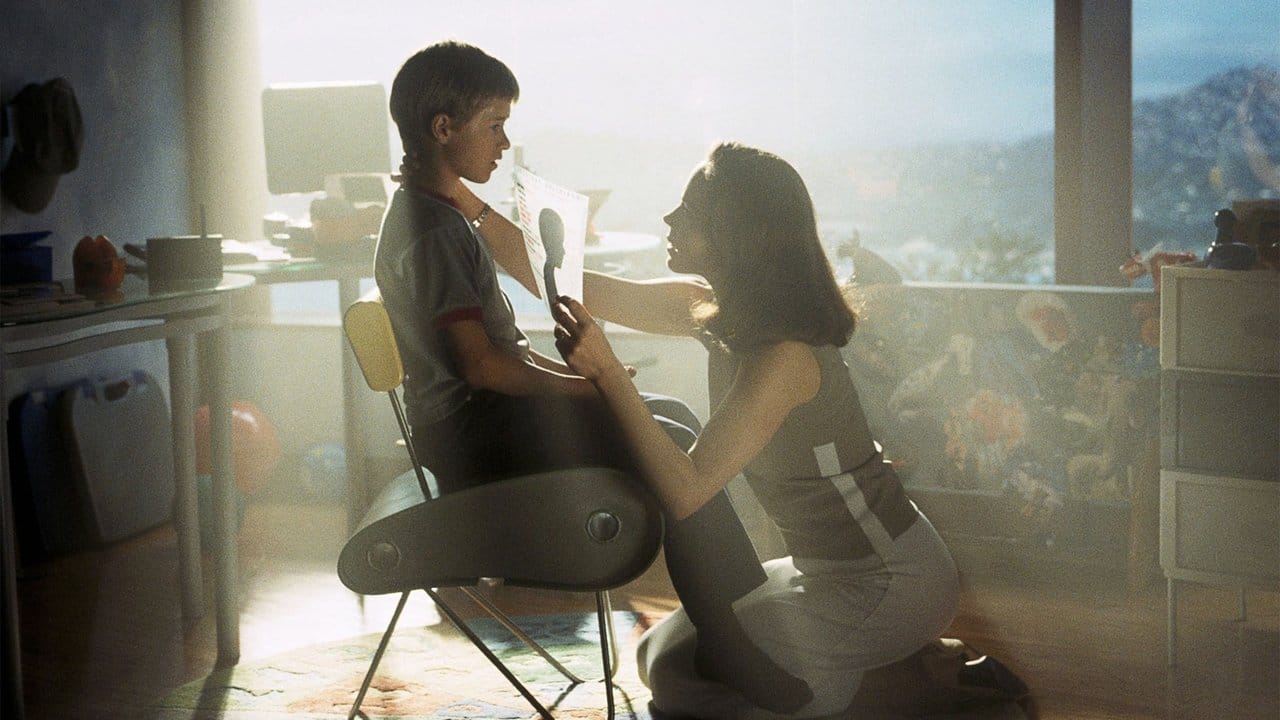
David is 11 years old. He weighs 60 pounds. He is 4 feet, 6 inches tall. He has brown hair. His love is real. But he is not.
DramaScience FictionAdventure
Synopsis
David, a robotic boy—the first of his kind programmed to love—is adopted as a test case by a Cybertronics employee and his wife. Though he gradually becomes their child, a series of unexpected circumstances make this life impossible for David.
Main Cast








More Like This
Communauté
7.3
Note Trakt
9.8K votes
10
1.3K
9
831
8
2.3K
7
2.7K
6
1.5K
5
461
4
282
3
100
2
100
1
84
40.6KSpectateurs
189.9KCollectés
16.6KListes
Avis de la communauté (9)
D
Danio1972★8/10Sep 1, 2015
♥13
A
AndrewBloomVIPCritique★8/10Nov 14, 2016
8.2/10. Almost every story about robots ends up being about humanity and personhood. The most unadventurous among them only confront the luddite question of whether an android could ever be sentient, could ever be a person, even though they’re made from circuits and gears rather than flesh and blood. (It’s a question that many great works, most notably *Star Trek: The Next Generation* have convincingly answered in the affirmative.) But the best works don’t just interrogate the question of whether a robot can be a human, but rather use the idea of the mechanical man to try to answer the question of what makes us human. Films like *A.I.*--and make no mistake, it’s a quality film—ask deeper questions about what defines humanity, what qualities, practices, traits do we possess as a species that makes us unique, and uses an outsider and imitator to do so, in the same way that learning a foreign language can help us to better understand our native tongue. Thus *A.I.* tells us the story of a young “mecha” child who wants to be a real boy. The film wears its *Pinocchio* influences on its sleeve, and to that end, offers an updated, sci-fi-infused version of that story. In it, David, an android child, wonders what it takes for him to become real, for him to become human. The answer offered is an intriguing one – love. What distinguishes David from his mecha counterparts is the fact that he can “imprint” on his mother, that he can have an innate attachment to her beyond his own control. But it’s not the trite Hallmark Holiday version of love. The film presents something far more melancholy, far more heartrending, in its conception of “love” as an essential ingredient in humanity. In essence, the film posits that what makes us human, our distinguishing feature, is our ability to love something so much that we yearn for the unobtainable, that we reach for simulacra and last gasps of things we can no longer have. The kind of love that makes us human is the one that makes our attachments run so deep that they survive the people we were attached to, that they drive us to try to recapture things we know are lost and can never be recovered. That is the crux of this film. It repeatedly shows us individuals who reveal their humanity through attempts to revive their loved ones, to find something to fill the holes in their hearts left when they lost those closest to them. Monica, David’s would-be mother, accepted David as a fill-in for her own son who is in suspended animation after some disease or accident that ripped him from her. She is reluctant at first, but soon finds that David is a means to ease her pain, to make this inevitably misguided attempt to bring her child back in a fashion. That motif is repeated when David finally makes it to his creator’s workshop, and discovers that he himself was made in the likeness of Professor Hobby’s dead son. He too is living monument to the attempt to hold onto something lost, because the love imbued in that person is too much for to allow his maker to let go. Of course, *A.I.* is also interested in the morality of creating something that can love, that must love, and which we may not love back. The film’s opening act--which centers on the process of the Swinton family learning to love David, having their flesh and blood son come back to life, and then slowly but surely coming to the decision that David, for manipulated but understandable reasons of safety, no longer has a place in their family—is the tightest of the film. It tells a heartbreaking story of a young man becoming a fixture, becoming a part of a home of love, and then being put out when he no longer makes sense there. In particular, the scene where Monica abandons him in the woods, and he offers impassioned pleas and promises that he’ll be better, than he’ll be realer, to no avail, is utterly devastating. But it incites the middle act of David’s *Pinocchio*-like adventures, which prove to be the weakest part of the film. There’s thematic meat in the “Flesh Fare” portions of the film, which communicate the fears of a human population concerned that they’re being replaced by technology in a way that feels terribly prescient now. It also explores the way in which children are uniquely situated to earn our sympathies, that they speak to an innate sense of protection and preservation that manage to cut through even the chauvinistic prejudices of a bloodthirsty crowd desperate for mecha torture. For the most part, however, these scenes feel like simple ways to fill in struggles between David being kicked out of his home, and him becoming a real boy. His adventures with Gigolo Joe and Teddy (who work as his companions in the vein of Jiminy Cricket) make gestures toward the larger themes of the film, and offer some red meat to science fiction fans both in terms of world building and gorgeous, otherworldly set pieces and sequences that still look superb despite being a decade and a half old, but mostly feel like less compelling detours to the larger story being told. Flesh Fare, Rouge City, and the sunken bones of Old New York are entertaining enough as standalone pieces, but don’t have the thematic coherence of the rest of the film. That coherence comes in the film’s much maligned end game. While a 2,000 year wait and the presence of aliens may have been off-putting at first, they work as the true equivalents to the blue fairy that David is so desperate to find – the effectively supernatural force that can intervene and grant David’s wish. And they do. What David wishes for more than anything in the world is to return to his mother, so the aliens revive her for one more day. It is in that final montage, where David gets to celebrate his birthday, to tell his mother his life’s story, to share in the joys and the pains of love and loss, that he truly becomes a real boy. What makes him so is the way that he shares in the efforts of Monica Swinton, and of Professor Hobby – his desire to recapture something lost, because he loves someone, and he can’t turn that off just because they’re gone. His revival of Monica, his desperation to enjoy one last day with her, one last simulacra of where his love led him, shows that David has a soul, however you’d like to define that term. As the similarly precocious Lisa Simpsons once put it (via writer Greg Daniels) some philosophers believe that a soul is not something we are born with, but rather something we earn, through suffering, struggle, and acts that reveal our humanity. David has done all that and more, coming close to death, traveling great distances, showing his devotion and futile hope for millennia, in the hopes of being able to return to his mother. So when he does, when he gets to spend that one last glorious day with her, it’s not just the culmination of the story, it’s his reward for his steadfastness, and the confirmation that he is a human being, in every meaningful sense of the term. It is moving when he hears the words he so desperately wanted to hear ‘lo those many years – that his mother loves him, that she’s always loved him. It is then that he not only becomes “real” but becomes whole, the gaping hole inside of him is filled. In the end, David wants without reason, he wants beyond reason, and like the little wooden boy who inspires him and those telling his story, eventually, his wish is granted, and he knows the profound pain and immense joy that comes with being a human being. The boy who was treated as much like a child as a person, turns out to be the last bastion of humanity, the legacy of our sins and our aspirations, at the end of the world.
♥10
J
JordyepVIPCritique★5/10May 21, 2019
Conceptually interesting, but we’ve seen it done better in other movies and even tv shows at this point. Yes, I certainly can’t deny that the acting and visuals are brilliant. Also, the action scenes and worldbuilding are magnificent. Can you tell it was made in the early 2000’s? Absolutely, the cyberpunk look is ever so present in a lot of scenes, but that’s not bothersome. In fact, I think it’s awesome. Furthermore, this story goes in directions you don’t expect. It takes a while for the real adventure part to kick in, and only then you’ll realize that the first act was just a lot of character development. This film fails on a point where Spielberg hardly ever failed: tone. As you probably know, this film was originally intended to be directed by Stanley Kubrick. His dark touch is felt, and it really doesn’t mix with Spielberg’s whimsical style at all. For example, do PG-13 Ted and an Einstein cartoon played by Robin Williams feel as if they belong in the same movie as where a mother leaves her own kid behind in the forest, and cries her eyes out for doing that? Unfortunately, they don’t, which results in bizarre tonal shifts throughout the film. Moreover, I found the choice to have the AI act like our stereotypical imagination of robots a mistake, as it makes it harder to connect to the characters, or understand certain choices of human characters in the first act. Finally, certain scenes were, in the larger scope of the story, unnecessary (e.g. Brendan Gleeson’s circus show). Removing those scenes would’ve sped up the pacing and shortened the runtime, something this film needed. 5/10
♥6
D
DRNKMNKY★5/10Jul 27, 2015
♥6
D
Draackje★4/10May 30, 2011
This starts with a great concept about a robot experiencing human emotions and the consequences that would have. The movie also starts off pretty decent by showing how an emotionless robot is pretty scary, but how emotional humans are also pretty scary. Then it turns into a carnivalesque chase/quest, which is funny, exciting and looks amazing: great mid-story. There were a couple of ways I could see this end, so I figured it would lead to something great. And then, when I least expected it, I got to witness the worst ending I'd ever seen in a sci-fi movie (or Indiana Jones 4), guided by a voiceover (!) literally explaining the moral of the story over and over for 20 minutes. I was willing to look over some plotholes and some annoying characters (yes teddy and mommy, i'm looking at you) because I liked the fact this movie made me think about what it means to be human. But the ending changed this from an above average movie to a terrible movie. It made me ashamed to be a sci-fi fan...
♥3
Reviews