Loading...
7.1·1994·121 min·English·Directed by Bernard Rose
DramaMusicRomance
Synopsis
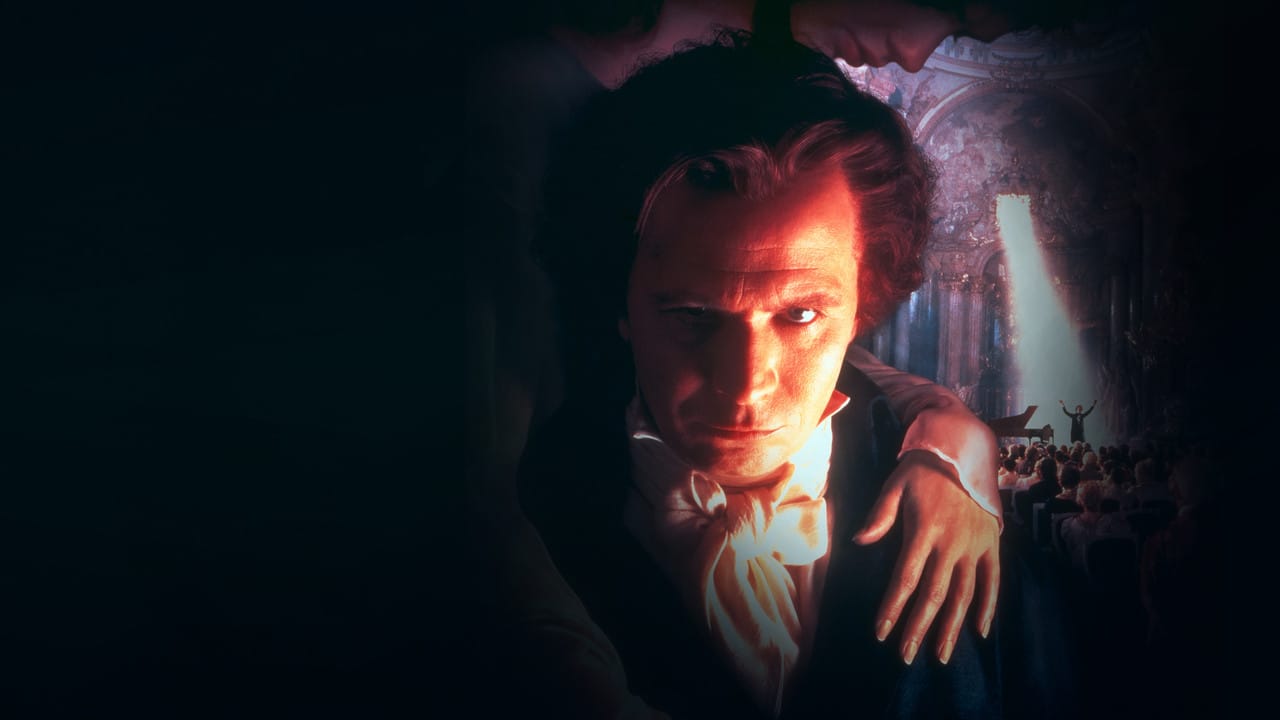
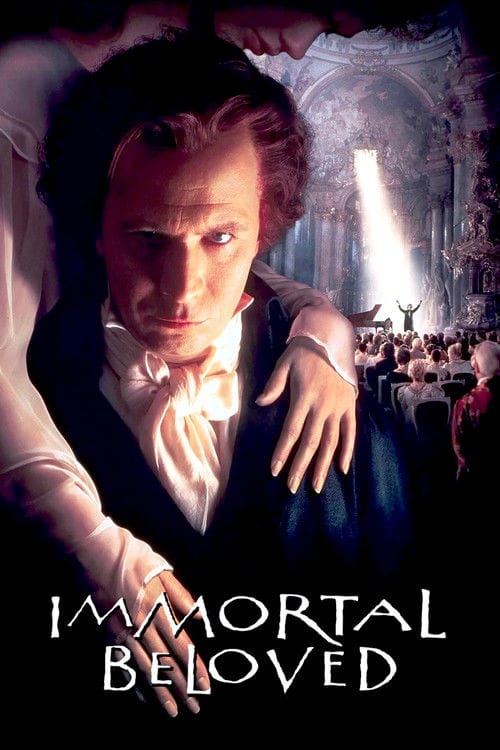
A chronicle of the life of infamous classical composer Ludwig van Beethoven and his painful struggle with hearing loss. Following Beethoven's death in 1827, his assistant, Schindler, searches for an elusive woman referred to in the composer's love letters as "immortal beloved." As Schindler solves the mystery, a series of flashbacks reveal Beethoven's transformation from passionate young man to troubled musical genius.
Main Cast

Gary Oldman
Ludwig van Beethoven

Jeroen Krabbé
Anton Felix Schindler

Isabella Rossellini
Anna Marie Erdödy

Johanna ter Steege
Johanna Reiss

Marco Hofschneider
Karl van Beethoven

Miriam Margolyes
Nanette Streicherová

Barry Humphries
Clemens Metternich

Valeria Golino
Giulietta Guicciardi

Gerard Horan
Nikolaus Johann van Beethoven
Christopher Fulford
Kaspar Anton Carl van Beethoven
More Like This

Communauté
7.4
Note Trakt
520 votes
10
82
9
45
8
128
7
132
6
74
5
28
4
19
3
2
2
2
1
7
1.4KSpectateurs
25.3KCollectés
1.7KListes
Avis de la communauté (3)
S
SimonYNWAVIP★10/10Aug 16, 2014
Oldman is magnificent and the story, while not historically accurate, is gripping. Bernard Rose's choice of particular pieces of Beethoven's music to match the scenes in question is more often than not inspired. The "Ode to Joy" sequence, played to Beethoven's memories of his childhood, is frankly one of the finest musical sequences committed to film and the finale is heartbreaking.
♥5
S
Spiritualized Kaos★8/10Aug 27, 2024
Romantic review of Bethoven's life.
L
LNeroCritique★8/10Jul 22, 2024
While not as sumptuous and darkly baroque (in tone, and visually, of course) as _Amadeus_, and I'm sure no end of liberties were taken with the story, this had me hooked from beginning to end, and it kept its secrets and made me retroactively feel a fool. Bravo. I used to not like Oldman in the films I'd seen him in that were my introduction to the actor (Stanfield in _Léon_, and his wildly goofy Zorg, as well as other family fare like _Lost in Space_) but I like him in roles such as this, where he can be disordered and abrasive, but also more even keel, while feeling natural all the way through. Jeroen Krabbe is always a treat to watch, and has a genuine depth of humanity and empathy more than most any actor I can think of. The women—Isabella Rossellini, Johanna Teer Steege, and Valeria Golino all left lasting impressions. Even compared to Rossellini, Golino's yearning eyes just won't let you look away. There are some gorgeous costumes (Oldman's and Golino's especially caught my eye), and locations, and a few gorgeous interior shots. The makeup was slightly distracting. I paused the film and went down a little rabbit hole after seeing Golino in her dresses, with what I learned is called an "empire waist" from the AI on Perplexity, and that apparently, it was a late 19th century fashion in France and Austria to have a sheer top, nipples and all. Of course, this scandalized and was resisted in England. Fucking (actual) Puritans. Living in the Anglosphere really does leave you feeling like you've been living in some body shame and sex guilt colony—just one the size of two empires. I've been atheist for over half my life, and the provinciality is still an innate, internalized part of my mind. I committed a minor crime, not having been able to watch this with a proper sound system, but the music needs no comment, (it's all Beethoven, back to front) and I knew 90% of almost all of the pieces by heart from listening to them as a boy (thankfully CDs don't wear out from play, without abuse). I will have to watch it properly in the future, as I know it doesn't have the proper effect without full spectrum sound waves thundering into your body. The revelations at the end caught me completely unaware. No spoilers, but the subtitles never seemed to cover the scrawled German text, and I am terrible at reading bad chicken scratch, and cursive, especially in a second language, so I had to work through it, but the notes scribbled near the end read: > _Muss es sein_? (Must it be?) _Es muss sein._ (It must be.) Gotta love that 19th century solemnity. I haven't given due credit the the performances, costumes, production design, cinematography etc., but the film is good to great on all metrics. Although... there were a couple of scenes that were supposed to be serious that I just could not keep myself from laughing, either due to the comi-tragic nature of the scenario, or the editing, as two death scenes both made me chortle right at the cut. I'm sorry, but people dying to Beethoven symphonies/concertos, etc. is too close to parody for me to take with a straight face. (This is set during the Napoleonic wars, so people dying is not a spoiler.)
Reviews