Laden...

6.7·2025·120 min·English·Regie Scott Cooper
DramaMusik
Handlung
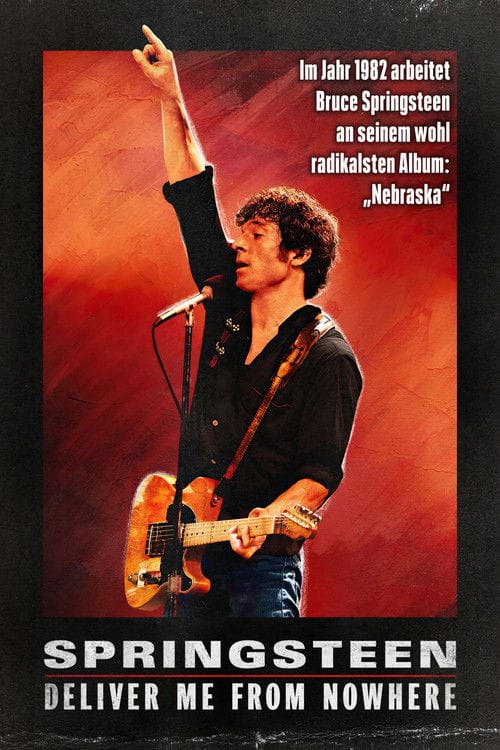
Im Jahr 1982 arbeitet Bruce Springsteen – im Film verkörpert von Jeremy Allen White – an seinem wohl radikalsten Album: „Nebraska“. In einer Phase innerer Zerrissenheit, in der ihn der eigene Ruhm zunehmend zu erdrücken droht, entscheidet er sich bewusst gegen das Tonstudio. Stattdessen zieht er sich in die Abgeschiedenheit seines Schlafzimmers zurück. Dort entstehen keine mitreißenden Rockhymnen, sondern düstere, zerbrechliche Songs – Geschichten von Schuld, Verlorenheit und Gewalt, aufgenommen auf einem einfachen Vierspurgerät. SPRINGSTEEN: DELIVER ME FROM NOWHERE zeichnet ein intimes Porträt eines zerrissenen Künstlers, der mit inneren Dämonen ringt – und dabei unbeabsichtigt ein Meisterwerk der Musikgeschichte schafft.
Hauptdarsteller










Mehr wie das

Back to Black
2024·6.7

Elvis
2022·7.5
Jersey Boys
2014·6.8
I Saw the Light
2016·6.2
Elvis
1979·6.8

Whitney Houston: I Wanna Dance with Somebody
2022·7.0

Grace Unplugged
2013·6.0
Thirty Two Short Films About Glenn Gould
1993·7.0

Respect
2021·6.8

Teen Spirit
2019·6.0
tick, tick... BOOM!
2021·7.6
Inside Llewyn Davis
2013·7.2
Communauté
6.8
Note Trakt
2.0K votes
10
189
9
80
8
417
7
442
6
584
5
157
4
107
3
27
2
22
1
17
10.7KSpectateurs
14.9KCollectés
3.7KListes
Avis de la communauté (12)
J
Jlloyd2000Critique★7/10Oct 31, 2025
A decent film that could’ve been a great one, but it leaves a lot on the bone. I find musical biopics too naff for the most part so I was glad the Nebraska album was the focus of the film, and more specifically the transition period from ‘Big and Famous’ to ‘Global Megastar’, and his issues in crossing that bridge. Nebraska is specifically the perfect point of focus as it covers a lot of his angst and guilt about moving on. JAW as Bruce is pretty remarkable, at least on-stage. He’s got the stance, the shoulders, and the mannerisms down to a tee and his singing voice is excellent. The speaking voice less so. Jeremy Strong as Jon Landau is perfect casting – all sincerity and thinly suppressed panic; and Stephen Graham is, of course, exactly right. The film’s big risk is trying to dramatise something almost defiantly undramatic – a guy sitting alone in a rental house, depressed, tinkering with four-track levels and listening to Suicide on repeat. But, much like Nebraska, that’s kind of the point. It’s stripped back, it’s low-key, and it’s honest. The problem is it wasn’t really clear this was a film largely about depression until quite late on. Bruce breaking down in tears at therapy felt like a finale that hadn’t really been built up to properly – like it remembered it wanted to about this specifically with 30 minutes left. I’d also have lost most of, if not all, the love interest story completely and gone deeper into the creative friction: the push-pull with Landau, the record label, the band etc., and how that impacted the music and how it got made. They do that a bit, but again, it’s undercooked. I think the flashbacks broadly worked well, but some were used a bit clumsily (the Mansion on the Hill scene is stupid. We get it. The mansion was on a hill. Cheers). Loved the Nebraska song scenes though. Bruce identifying with feeling lost and the rage that comes with that and shifting the lyrical perspective to first person – genuinely fucking great, one of my favourite parts of the film. Again, I wanted more of this though. More of Bruce wrestling with himself, more glimpses into how his darkness fed the songs. We got one layer peeled back when we needed three. The “in this office we believe in Bruce Springsteen” line though – beautiful. Print it on a mug immediately. As far as the ending, the scene with him sitting on his old man’s lap was really moving but besides that the final 20ish mins sagged due to the lack of setup. That said there’s more than enough to enjoy in the first hour and a half to carry it through, and I had a good time. It ain’t a beauty, but hey, it’s alright.
♥6
B
BobboRobbo91★10/10Oct 24, 2025
Just watched yesterday at the cinema, it's something unbelievable. I didn't know Bruce had a life so similar to mine... Well, what else can I say? I was moved and cried in almost every scene... Especially those with his father. Now I understand why, just listening the first time some songs I felt like a punch in the stomach. Fantastic person, fantastic artist. I honestly don't think I'll be able to see it again... Too true for me.
♥5
H
hgram★6/10Nov 19, 2025
"So it's like this the whole way through? Can we stop it?" For a Bruce Springsteen movie, this is oddly flat and lifeless. Script is impressively boring; story arc virtually non-existent. The central dramatic conflict in this movie is whether you can record an album on a cassette tape. (I'm not kidding.) Man that script needed work. It's a pity, because everyone else is at the top of their craft. Very sweaty lead performance. And I love when movies look like movies. The world used to be slower. I think it was better that way.
♥3
M
mezzerin★10/10Oct 25, 2025
Absolutely great movie! Its dark and emotional, so be ready.
♥3
D
decatur555VIPCritique★8/10Mar 2, 2026
The best thing a music biopic can do is send you home wanting to play an album. Springsteen: Deliver Me From Nowhere does exactly that. Instead of stadium anthems and triumphant montages, it places you in a small, almost claustrophobic room where a thin, restless artist records Nebraska as if whispering a confession. Scott Cooper keeps the film deliberately restrained. He avoids spectacle in favour of a dry, introspective tone that can feel distant at times. For viewers expecting a conventional rise-and-fall biography, this may seem underwhelming. But that narrow focus is precisely what sets it apart from assembly-line rock biopics. This isn’t about glory; it’s about isolation and the need to strip everything back. Jeremy Allen White delivers a remarkably nuanced performance. Rather than impersonating Springsteen, he captures an emotional essence —the hesitation, the inwardness, the weight of expectation. His vocal work adds authenticity, and there are moments when you forget you’re watching an actor playing an icon. Instead, you see a man struggling to reconcile success with inner emptiness. The film isn’t flawless. Some flashbacks to childhood and the strained father relationship feel overly familiar, and at times there’s a faint whiff of reverence that softens the edges of what could have been a harsher portrait. Structurally, it remains more conventional than its tone suggests. Where it truly comes alive is in the creative process. The lo-fi recording sessions, the refusal to polish imperfections, the anxiety about alienating audiences —those scenes carry a quiet power. You feel the solitude that shaped Nebraska, and the artistic risk behind choosing vulnerability over spectacle. It’s not monumental cinema. It’s a character study —sometimes uneven, but sincere. And if it leaves you listening to “Atlantic City” with fresh ears, then it has done something meaningful.
♥2
Kritiken